

Written by: Mitch Madill
In October 2022, a SOLO Landlords member logged into his CIBC banking app and saw something he did not recognize: a new CIBC Aventura Visa card attached to his profile.
He had not opened it.
He contacted the bank and was told he may have been the victim of identity theft. When he went to a branch, he says he learned that someone had allegedly opened an account in his name at a branch in London, Ontario.
But he lived in Toronto.
The bank told him to file a police report, which he did with Toronto Police. But according to the member, the report did not lead to answers.
The problem did not stop with one card. He says his credit profile was hit with 26 applications and inquiries, with bank and credit-card documents being mailed to his home. His credit score, which he says had been around 850, dropped to approximately 440.
Over the next year, while dealing with financial institutions and Equifax, the member says he discovered a key detail: someone had allegedly tried to open a line of credit at a paydayloan business using an Ontario ID card with his name, but a different photo and a London address.
According to the member, the payday-loan company’s fraud team told him the Ontario ID card had allegedly been obtained using foreign identification at ServiceOntario. The company could not release the supporting records directly to him, he says, and told him police would need to obtain them through a production order. The member says Toronto Police took his report; however, he did not receive further answers through that process.
But the member wondered, how could an Ontario-issued ID allegedly be created in someone else’s name, with a different photo and address, and then be used in financial applications?
The Ontario Photo Card application form is titled “Application for Ontario Photo Card — Ontario Residents Only.” It states that, under the Photo Card Act, 2008, a person must be a resident of Ontario to obtain an Ontario Photo Card.
The concern comes from what the form appears to ask for.
The applicant declaration requires the person to declare that Ontario is their primary place of residence and that they are not a visitor.
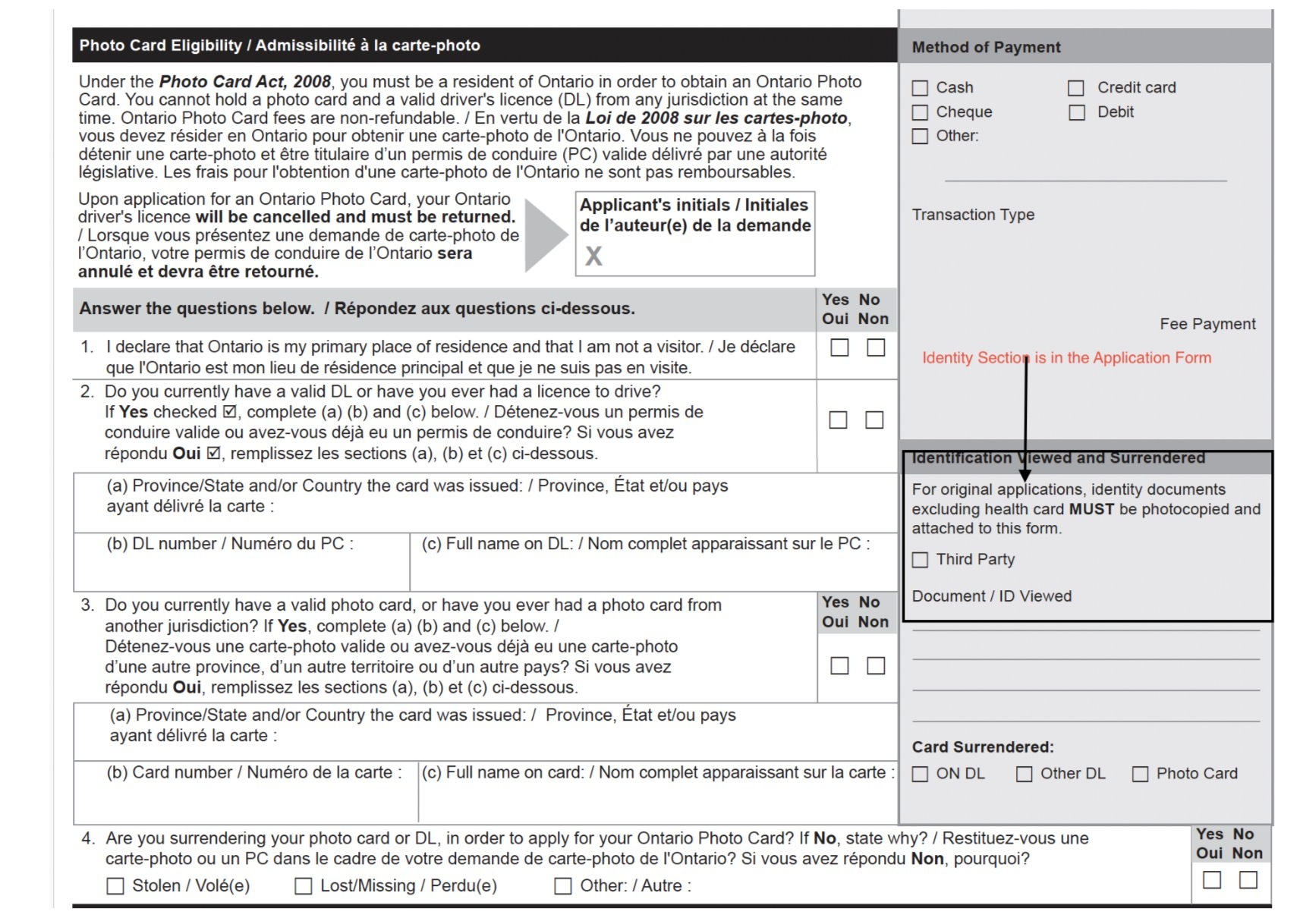
*Ontario Photo Card application showing the applicant declaration that Ontario is their primary residence and that they are not a visitor*
For a new or replacement Ontario Photo Card, the form also refers to proof of legal name and date of birth.
What does not appear on the face of the form is a requirement to provide documentary proof of Ontario residency or documentary proof of lawful presence in Canada.
The distinction is important. There is a difference between requiring someone to be an Ontario resident and requiring that person to prove it with supporting documents.
After discovering the alleged Ontario ID connection, the member began pushing for answers.
He wanted to know how many Ontario Photo Cards had been issued using foreign passports, and how many of those cards were later used in the driver’s licence application process.
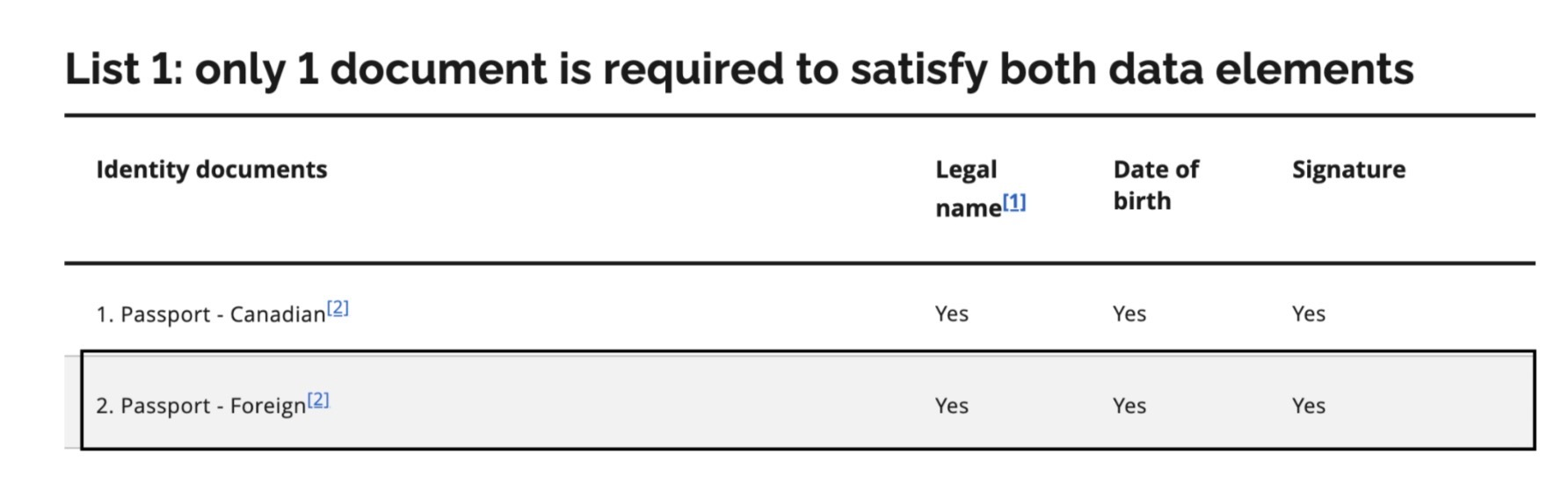
*Acceptable identity document list showing a foreign passport as one document that can satisfy legal name, date of birth, and signature requirements*
According to the correspondence provided to SOLO Landlords, the Ministry response was that it did not have responsive records and did not track the information in the way requested.
The member challenged that answer. His concern was straightforward: if the application form appears to record what identity documents are presented, why could the government not determine what documents were used and whether a Photo Card was later connected to a driver’s licence application?
He also says the process exposed confusion between ServiceOntario, the Ministry of Public and Business Service Delivery and Procurement, and the Ministry of Transportation. For a victim trying to understand how an Ontario ID was allegedly created in his name, that confusion was not just bureaucratic, it was personal.
The member’s concern was not only that his identity had been stolen. It was that the application process appeared to rely on a declaration of Ontario residency, while the government’s own later briefing materials stated that applicants were not, at the time, required to verify residency or legal status.
The most difficult part was not only the fraud itself. It was trying to find out who was responsible for answering those questions. The bank sent him to police, the fraud team said records required a production order. ServiceOntario, MTO and other ministries became part of a paper trail that was difficult for an ordinary person to navigate.
If an Ontario ID can allegedly be created in another person’s name, the public should be able to understand how that happened, which government body is responsible for investigating it, and what process exists to prevent it from happening again. Until those answers are clear, victims are left chasing departments, and the public is left with unanswered questions about a system it is expected to trust.
This article is based on the Ontario Photo Card application form, Ontario government Bill 60 materials, the government’s technical briefing deck, acceptable identity-document materials, and correspondence and personal account provided by a SOLO Landlords member.
Ontario Photo Card application form: https://forms.mgcs.gov.on.ca/
Bill 60: https://www.ola.org/en/
Photo Card Information: https://www.ontario.ca/page/